

Paper folding is often framed as “making something.” But in practice, folding is a way of organizing time, attention, memory, rules, and bodily sensation into a temporary order. Origami can be craft, yes-but it can also function as a small ritual, and at times a self-regulation device. The deeper question is less “What will I create?” and more “What state am I entering?”
1) Folding is not the destruction of possibility—it is the selection of possibility
A flat square holds countless potential forms. The moment you fold, the field of possibilities narrows. That can sound like constraint. Yet it is also a decision: this way, not every way.
Folding becomes a practice of choosing a direction under uncertainty-often a stabilizing move when “everything is possible” feels less like freedom and more like noise.
2) Folding is a method of time management
Origami forces a relationship with pacing. Rushing produces misalignment; misalignment destabilizes what comes next; then the urge to restart appears. Folding quietly asks:
Can you hold a steady tempo? Can you correct without panic? Can you tolerate the desire to undo?
In that sense, folding is not only shaping paper; it is shaping rhythm. The hands learn a principle that the mind often resists: change happens through small units, not violent leaps.
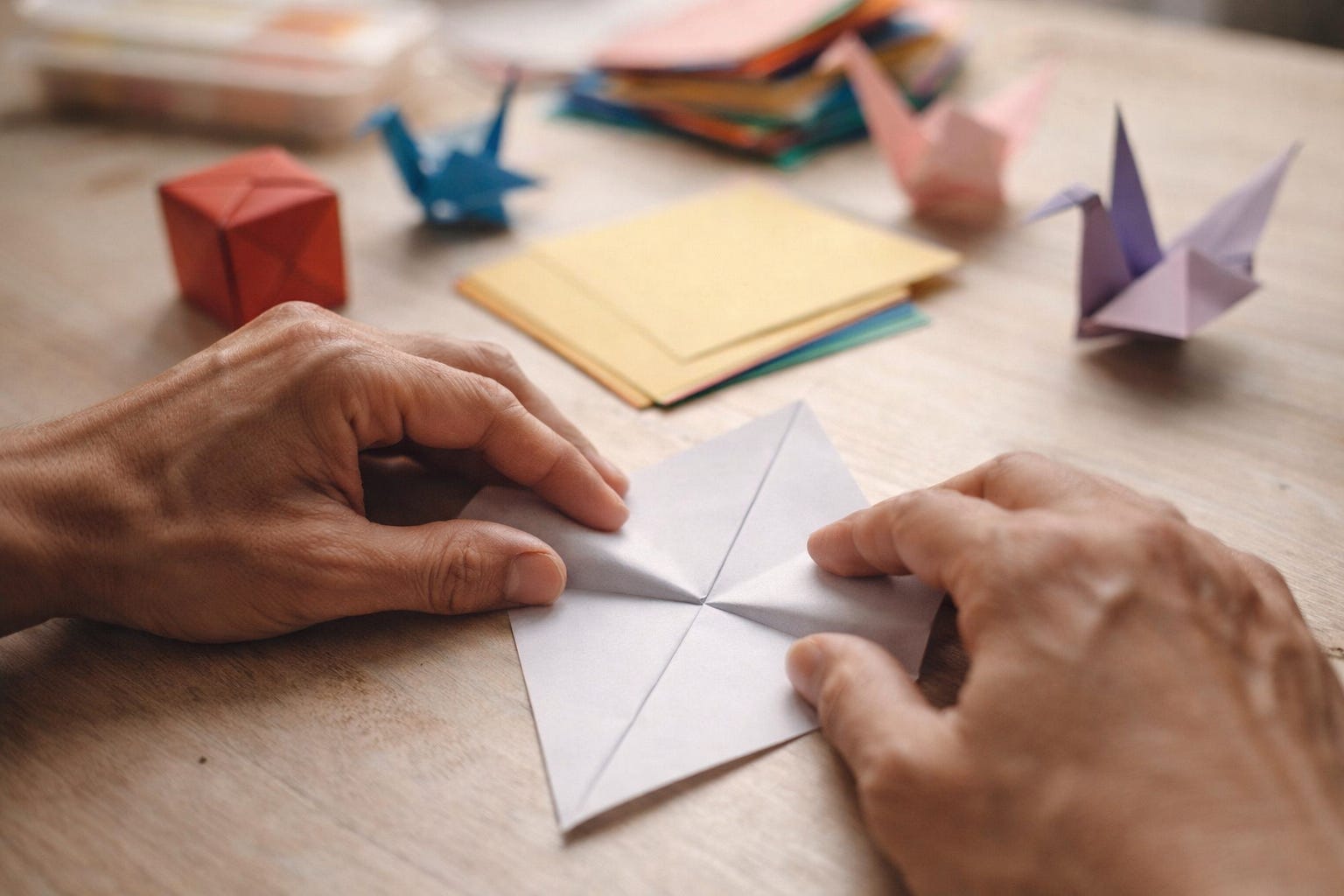
3) Folding trains how you handle error—and the shame that sometimes follows
Origami is psychologically demanding because mistakes become visible quickly. Small inaccuracies amplify. This can trigger familiar scripts: “I’m bad at this,” “I’m too slow,” “I’m ruining it.”
But folding also offers alternatives to self-attack. When an error appears, you usually have options:
adjust it now, or
continue and compensate later.
The “lesson” is not perfection. It is learning that after error, there are pathways other than collapse.
4) Folding is a sensory anchor: returning from thought to contact
Many people struggle with meditation because attention gets hijacked by thinking. Paper is helpful because it is concrete: it has texture, resistance, edges, sound, and visible lines.
Attention moves from narrative (“What’s wrong with me?”) to contact (“Are the corners aligned?” “How much pressure?” “What do my fingertips feel?”). Folding becomes a structured attentional shift—an external anchor that makes presence more achievable.
5) Folding is a way of holding memory: creases as traces, not damage
Once paper is folded, a trace remains. Even if you unfold it, the crease does not vanish. That simple fact can carry meaning: the goal is not to return to a pure beginning. Paper does not “reset” into innocence—yet it becomes more foldable, more structured.
Without romanticizing suffering, folding still demonstrates something clinically relevant: traces can become structure. Recovery is not always erasure; sometimes it is re-organization.
6) Folding is relational: pace becomes ethics in a group
Alone, folding trains internal tempo. In groups, folding reveals the social question: whose pace sets the norm?
Good origami meditation design avoids forcing an average speed. It builds in pauses, repetition, and flexibility so that participants can stay regulated rather than “keep up.” What looks like a simple activity becomes an ethics of inclusion.
Conclusion: folding paper is practicing a small way of living
Folding does not promise dramatic revelation. It offers something quieter and more practical: a rehearsal of how to
choose, pace, repair, return to sensation, accept traces, and share rhythm with others.
In that sense, folding paper is not merely producing a form. It is practicing-through the hands-a more workable relationship with life.