

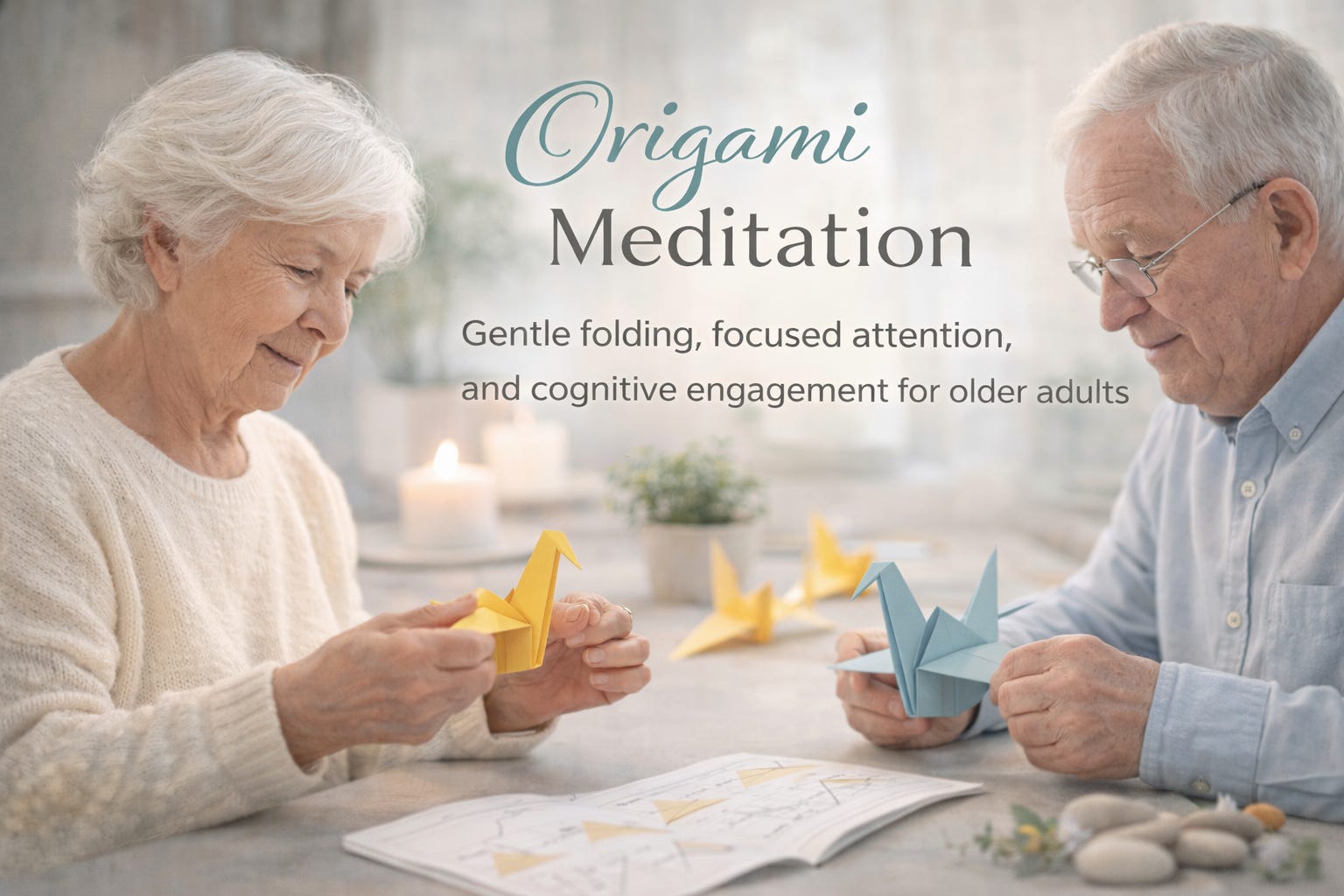
There are countless origami classes. The issue is often the design: many are built around finishing a model quickly, measuring success by the final product. For seniors, that structure can collide with real constraints-processing speed, working memory load, visuospatial alignment, hand comfort, and fatigue. Falling behind easily becomes “I can’t do this,” which is not a minor inconvenience; it can shape avoidance and withdrawal.
Origami meditation flips the frame. The goal is not technical mastery or production—it is a repeatable ritual that uses folding sequences, sensory attention, breath, and pacing to support grounding and emotional regulation. For seniors, the most therapeutic variable is not “perfect folding,” but steady re-entry: slowing down, correcting gently, and returning after error.
Fast classes produce objects; slow rituals build function
Seniors need pace-control and repair space more than “skills”
Outcome-focused sessions often follow a predictable arc: demonstrate → imitate → fall behind → miss the moment to ask → feel exposed → quit. The core problem is not that origami is “too hard.” It’s that speed and evaluation consume cognitive resources that seniors may need for alignment, sequencing, and comfort.
In origami meditation, mistakes are not penalties; they are central. You open the fold, reset the line, adjust in the next step. That is not merely craft-it is attention re-setting. The mindfulness move of “returning” becomes embodied, not aspirational
Origami naturally embeds a gentle “brain exercise”
Sequencing, selective attention, and visuospatial alignment-without turning it into a test
Origami meditation quietly recruits key cognitive domains:
Working memory: holding “this step → next step”
Selective attention: tracking edges, symmetry, crease placement
Visuospatial processing: orientation, midline alignment, diagonal mapping
Executive function: slowing down, pausing, retrying, planning
This is cognitively engaging in a way that remains grounded in sensation. Observational evidence suggests that engagement in mentally stimulating activities is associated with lower risk of cognitive decline/dementia (association, not proof of causation). Alzheimer’s Society+2PMC+2
At a public-health level, major guidance emphasizes the importance of being cognitively active across the life course as part of broader dementia risk-reduction approaches.
“Hands and brain” is not just a metaphor
Fine-motor dexterity and coordination show meaningful relationships with cognition
Origami meditation uses fine motor control, bimanual coordination, and continuous sensory feedback. Recent work reports that fine-motor performance (dexterity/coordination/stability) is closely related to cognitive functioning, and hand-movement features can provide insight into cognitive brain function in older adults. PMC+1
The responsible conclusion is not “origami prevents dementia,” but rather: well-designed folding meditation is a cognitively engaging fine-motor routine that many seniors can sustain-often more easily than activities that demand higher physical exertion.
The senior-critical feature: a built-in self-worth buffer
Shifting the target from “perfect product” to “regulated process” reduces failure narratives
Outcome-driven classes tend to create an implicit grading system. Origami meditation changes the metric:
Not “a beautiful crane,” but
noticing sensation, lowering pace, and re-aligning after error
For seniors, this matters. If “I’m failing” repeats, avoidance grows. When the goal is rhythm-not performance-practice becomes durable.
For seniors, origami meditation is less a craft class and more a cognitive–emotional routine
What fast classes miss, slow ritual captures
For seniors, the point is not learning increasingly complex models. It is having a repeatable, calming protocol that trains attention, pacing, and repair—while keeping the hands and senses engaged. Dementia prevention cannot be promised, but the broader evidence base consistently values sustained cognitive engagement as part of risk-reduction frameworks. World Health Organization+2Chronic Disease Directors+2
Educational content only; not a substitute for individualized assessment or treatment.