

Meditation is often misread as “doing nothing.” For many people, especially under stress, it becomes the moment they finally notice what the mind does when it’s not occupied: urgency, regret, prediction, self-critique-arriving without an agenda. In that moment, what helps is not stronger willpower, but a practical support for attention. Origami provides one.
Origami is not useful for meditation because it is merely “pleasant.” It is useful because it makes attention concrete, synchronizes breath and pace without forcing, and teaches the central mindfulness move-returning after deviation-through visible, embodied repair.
When “Just Sit Still” Is Too Demanding
For many people, the doorway to stillness is precise movement, not total stopping
In anxiety, hyperarousal, or low mood, the instruction “watch your breath” can be surprisingly advanced. The body may be still, but the mind becomes sharper—and that sharpness can feel like pain. Add performance pressure (“I should be good at this”), and breath awareness turns into measurement.
Origami offers a different entry point: small, constrained, precise motion. The constraint is not a limitation; it is a boundary that prevents attention from scattering across an overly wide mental space. Sometimes meditation begins more reliably at a work surface than in an empty room.
Sensation Proves the Present
Paper resistance, alignment, and micro-pressure can only happen now
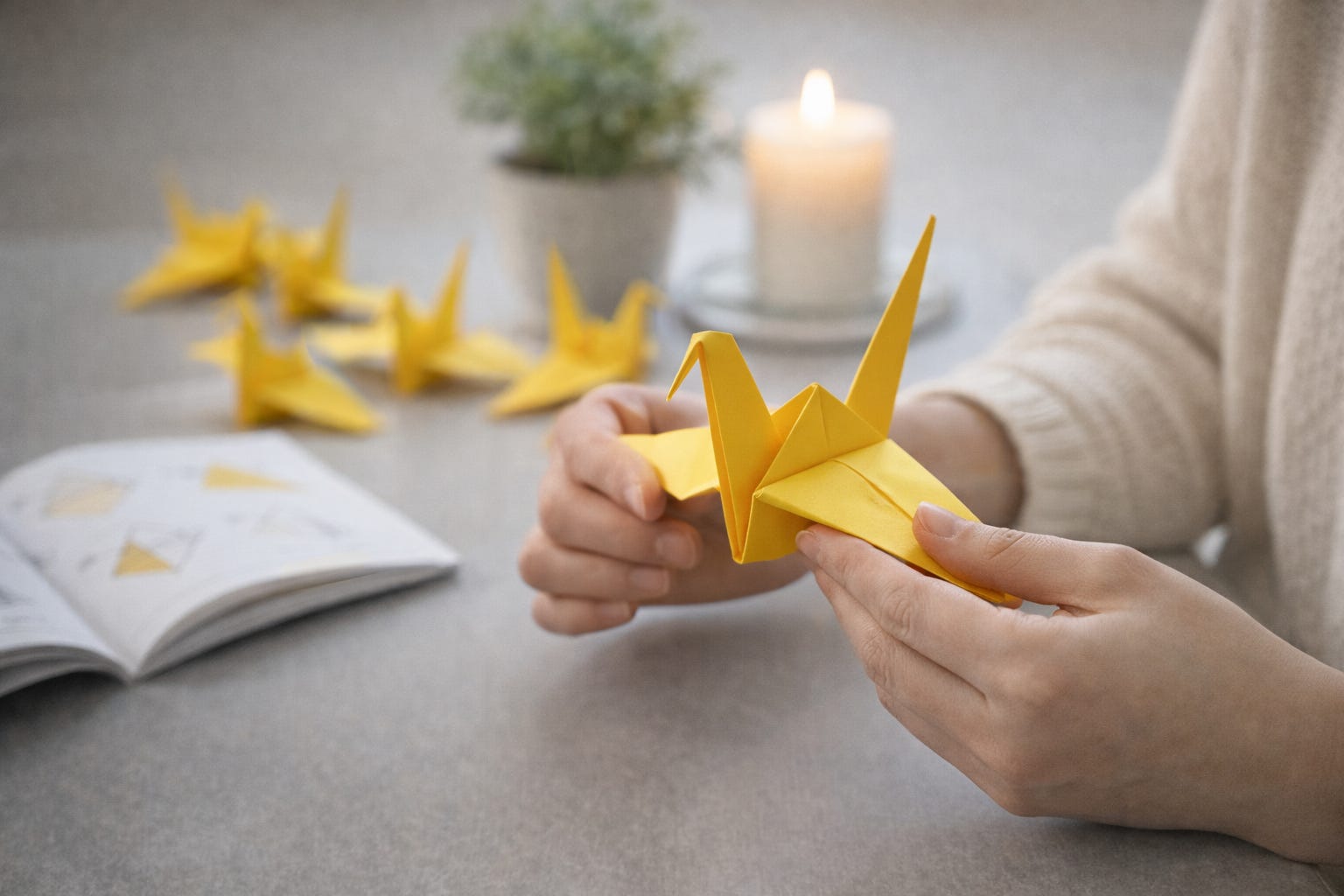
Thought can travel anywhere. Paper cannot. Origami asks you to feel grain, align edges, and set a crease with deliberate pressure. Attention shifts-almost automatically-into sensory channels.
The key is not telling yourself to focus. It is designing conditions in which focus happens. The edge must meet the corner. The crease must land. You cannot “replay” alignment the way you replay a worry. Present-moment attention becomes a practical necessity.
Sequence Aligns the Mind When the Mind Can’t
When inner order collapses, external structure functions like temporary regulation
Origami steps act like scaffolding. When the next move is clear, the mind asks fewer “What am I supposed to do now?” questions. Under anxiety, fewer options is not deprivation-it is load reduction.
In this sense, origami-meditation is less “skills training” and more “practicing reliance on sequence.” Technical mastery is not the goal. The goal is to experience how structure stabilizes attention. The product matters less than the placement of awareness.
Breath as a Side Effect, Not a Task
When calm isn’t demanded, calm occurs more often
Breath practices can become paradoxical: breath turns into a metric of how you’re doing. If it’s shallow, you worry; the worry makes it shallower.
In origami, breath is not foregrounded. You slow down for fine motor control, pause to align, exhale while pressing a crease. Breath becomes something that follows rather than something you must “do correctly.” Regulation shifts from command to condition.
Errors Become Repair Practice
The core mindfulness move is not perfection—it is re-alignment
A common inner critique in meditation is: “My mind wandered again.” That often translates to “I failed.” Origami makes error more explicit: a skewed crease, asymmetry, collapse of form. Yet most mistakes are not fatal. You open the paper, reset the line, adjust in the next step.
You learn not simply to tolerate “being wrong,” but to practice what happens after wrongness. Repair is a central regulation skill. Origami trains repair visually, tactilely, and sequentially. “Returning” stops being a concept and becomes a hand-level habit.
The Outcome Leaves a Small Proof
When practice becomes visible, low mood feels slightly less absolute
Mindfulness can feel intangible, which invites doubt: “Is this working?” Origami leaves an object-crane, flower, star-that becomes evidence: I held attention somewhere today.
Origami cannot replace treatment. But for low mood, where inactivity and reward loss often dominate, a small completion interrupts the narrative “I did nothing.” The interruption does not need to be dramatic. Recovery is often built from small repetitions, not grand decisions.
Not a Class-Closer to a Protocol
The aim is rhythm: attention, pacing, and repair, not technical mastery
You do not need to present origami-meditation as an “origami skills program.” The aim is attunement, not proficiency:
where attention lands,
how pace reduces scattering,
how you return after error.
Repeated experience of these elements is the practice.
Don’t argue with the mind-build conditions the mind can follow
Origami does not persuade the mind directly. It lets the mind follow the order of the hands: one sheet of paper, a few alignments, micro-pressure, and the breath that enters between steps. If meditation is less a talent than a set of conditions, origami makes those conditions unusually concrete.
Educational content only; not a substitute for individualized mental health treatment.