

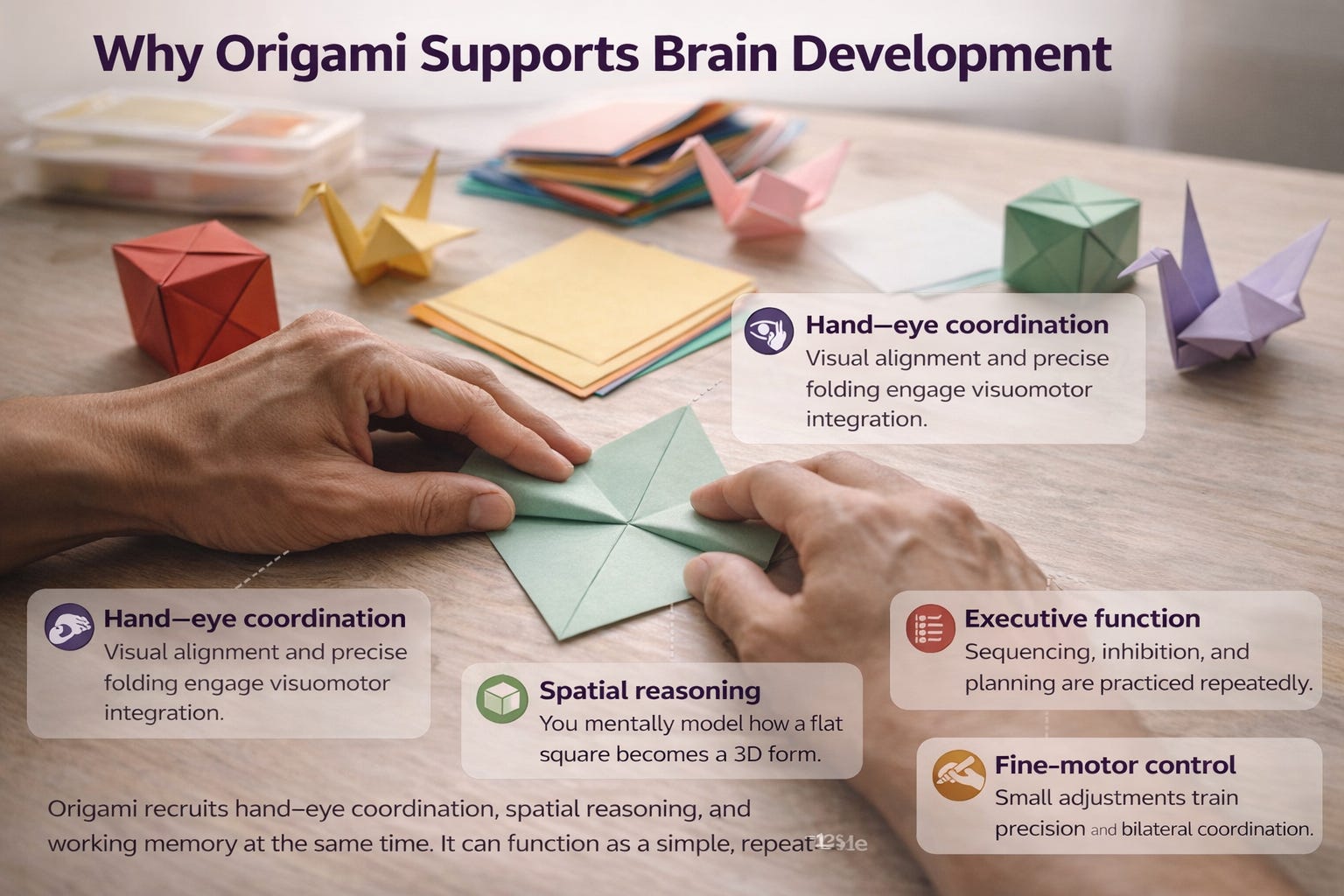
Origami is often treated as a “hand skill,” but it is better understood as a multi-domain task that recruits visuospatial processing, sustained attention, working memory, planning, error monitoring, and fine motor control. While folding, the brain is not simply repeating a motion-it is continuously predicting the next state, checking alignment, and correcting errors. In that sense, origami can be less about the finished product and more about the cognitive process that produces it.
1) Visuospatial processing: training the mind to transform space
Origami repeatedly reorganizes the relationship between lines, edges, and surfaces. Before the hands fold, the mind often “folds first.” Diagonal folds, symmetry checks, and rotations require spatial prediction and mental rotation. Origami has also been used in educational settings to teach spatial concepts such as symmetry, reflection, orientation, and spatial relations.
At the same time, evidence is not uniform across ages and designs; some studies report limited transfer to visuospatial outcomes depending on how training is structured.
This is why an origami meditation format prioritizes slow pacing, clear guidance, and repeatable structure over performance.
2) Executive function: sequencing, inhibition, updating, monitoring
Origami behaves like a recipe-except that a small error can cascade. Participants naturally practice sequencing, working memory updating, inhibitory control (slowing down to align), and goal monitoring. Reviews also highlight reciprocal links between motor skills and executive functioning across development. ScienceDirect
Origami sits at that intersection: fine motor precision paired with cognitive regulation.
3) Fine motor control and eye–hand coordination: stability through alignment
Good folding is less about force and more about alignment and calibrated pressure. Matching corners, pressing creases, and micro-adjusting edges all rely on eye–hand coordination. General clinical guidance on maintaining eye–hand coordination often includes detailed hand-based activities such as sewing/knitting and drawing. (Harvard Health)
Origami offers a similarly precise task, with the additional benefit of a slow, repeatable rhythm.
4) Attention and emotion regulation: an external anchor for the mind
Many people struggle with “empty your mind” instructions. Origami meditation provides a concrete attentional anchor—paper. Visual features (lines/edges), tactile feedback (resistance), and proprioception (hand position) create stable targets for attention. When paired with breath pauses and slow exhalations, attention can shift from rumination to sensory tracking.
Evidence suggests crafts-based interventions can support mental health and well-being, while also emphasizing the need for higher-quality research and clearer mechanisms.
Clinically, the accurate claim is modest: origami does not replace treatment, but it can function as a structured, sensory-based routine that supports grounding and regulation.
5) Older adults: best framed as a cognitive routine, not a skills class
Older participants often drop out of origami “classes” because the pace is fast and the focus is the final product. An origami meditation approach shifts the design: slower pacing, explicit steps, built-in pauses, and a focus on breath and attention rather than mastery.
Recent literature includes case-based cognitive stimulation reports and a review mapping origami’s cognitive effects and intervention protocols.
However, the evidence base is still emerging, so it is safer to avoid claims like “dementia prevention” and instead frame origami as cognitively engaging activity that may support attention, mood, and everyday functioning when practiced consistently.
Conclusion: Origami as a quiet device for cognitive organization
Origami does not “excite” the brain so much as it creates conditions for the brain to organize itself. Hands slow down, eyes verify alignment, the mind anticipates steps, and breath adds regulation. In that integrated loop, origami becomes more than a craft-it becomes a repeatable, real-life ritual that supports cognitive and emotional steadiness.
Educational content; not a substitute for individualized mental health treatment.
References (selected)
Bukhave, E. B., et al. (2025). The effects of crafts-based interventions on mental health and well-being.
Harvard Health Publishing. (2021). Activities to sharpen your eye–hand coordination.
Le Lagadec, D., et al. (2024). Healing Stitches: A scoping review on the impact of needlecraft on mental health and well-being.
Mendonça, A. R., et al. (2025). Cognitive intervention through the use of origami: a systematic/scoping review of evidence and protocols.
Mendonça, A. R. (2025). Cognitive intervention in a patient with dementia with Lewy bodies using origami stimulation (case report).
National Science Foundation. (2024). Addressing real-world challenges using origami (visuospatial learning context).
Sheng, S., et al. (2025). Reciprocal relationship between motor skills and executive functions (review).
Travers, B. G., et al. (2018). Knowing How to Fold ’em: Paper folding across… (review of paper-folding and spatial outcomes; mixed findings).